
Guide · Tantra
Tantra and tantric massage: meaning, practice and what to expect
An old word, a modern massage, and the quiet attention that connects them.
The COHEN team7 min read

Tantra is a family of esoteric traditions that took shape in India from around the middle of the first millennium CE, among some Hindu, Buddhist and Jain communities. Tantric massage is much newer: a modern Western adaptation that borrows tantra’s attention to breath and presence and turns it into slow, unhurried touch.
The two are easy to confuse, and both are often simplified. This guide keeps to what can be said with confidence, then describes plainly what a tantra session at COHEN is like. No background in yoga or meditation is needed, either to read on or to book.
01What tantra is, briefly
The Sanskrit word tantra comes from a root meaning to extend or to weave. It can mean a loom or the warp of a fabric, and by extension a system or a body of teaching. The texts known as Tantras were composed from around the sixth century onwards. They describe the esoteric practices of some Hindu, Buddhist and Jain lineages.
Tantra was never a single doctrine. It spans many schools, texts and teachers, and there is no universally accepted definition of it. A few features recur:
- Initiation. Practice was usually entered through initiation, and the relationship between teacher and student mattered.
- Sound and ritual. Mantras — sacred syllables or formulas — and ritual diagrams such as yantras and mandalas hold a central place.
- The body as a place of practice. Gesture, posture, breath and visualisation are means of practice, not distractions from it.
In the West, the word has travelled mostly in simplified form, and much of what carries the name today has only a loose link to these traditions. That is not a reason for suspicion. It is a reason to keep claims modest.
02Breath and awareness: what tantric yoga practises
Breath is where tantra and yoga visibly meet. In tantric yoga, breath control and posture were used to work with the body’s inner energy, often pictured as kundalini rising through the body. Breath regulation, or pranayama, also became one of the core practices of hatha yoga, whose first texts, from around the eleventh century, emerged partly from tantric circles.
Today, “tantra yoga” is a loose label. Classes under that name vary widely, but many combine slow breathing, meditation, chanting and close attention to sensation. Without the terminology, the skills are simple:
- letting the breath slow down without forcing it;
- resting attention in the body rather than in the day’s to-do list;
- staying with a sensation for a moment before judging it.
You can try a version now. Breathe in through the nose for a slow count of four and out for a count of six, and notice where the breath moves: chest, belly, back. Three or four rounds are enough, and if counting feels uncomfortable, simply breathe as you are. Nothing needs to happen. Noticing is the practice.
These are the elements a massage can borrow. It cannot borrow an initiation or a lineage — and an honest one does not claim to.
03From practice to massage: what “tantric massage” means today
Tantric massage is not an ancient Indian technique. It is a modern form of bodywork that developed in Europe in the second half of the twentieth century, drawing on the Western neo-tantra movement that grew from the 1960s. In practice, it usually means:
- Slowness. Long, continuous strokes, with pauses that belong to the rhythm.
- Breath. The guest is invited to breathe slowly and fully; sometimes the strokes follow the breath.
- Presence. The therapist’s attention stays with the person, not with a routine.
- Ritual elements. Some practitioners use a feather or a length of silk to draw attention to the surface of the skin.
There is no single standard, and what is included differs a lot between studios. The same is true of the related labels “sensual” and “erotic”, which we untangle in Sensual, tantric or erotic massage? A clear guide. Whatever word a place uses, ask what it means there before you book.
| Tantra, the traditions | Tantric massage today | |
|---|---|---|
| Origin | India, texts from around the 6th century | Europe, second half of the 20th century |
| Setting | Hindu, Buddhist and Jain lineages | Spas, studios and private practice |
| Practice | Initiation, ritual, mantra, meditation, yoga | Slow touch, breath, attention |
| Aim | Spiritual goals set by each lineage | Relaxation and presence |
04What a tantra session at COHEN is like
At COHEN, the tantra session is not a separate item on the menu but a stage within each ritual. It follows the relaxing massage, when warm oil and long strokes have already slowed the pace.
Before anything begins, there is a short consultation: how you feel today, anything you would like to avoid, the pace you prefer. Then your therapist leads, shaping the ritual around what you have said. You do not need to direct it.
In the tantra session, the touch becomes slower and more continuous, guided by breath and presence. Your breath sets the pace; there is nothing to do except let it slow down. You can keep your eyes closed, and there is no need to talk. The mood is meditative yet alert: deeply relaxed, but awake to sensation rather than drifting into sleep.
You stay in charge of your comfort throughout. Warmer, slower, lighter — say so at any moment, in a word or a gesture. The house rules are few and written down in our etiquette and FAQ: adults only, sober guests only, and all genders and orientations welcome.
A tantra session is part of each of the three rituals for one guest:
- Special session — 60 minutes, €200 (80 000 Ft). Relaxing massage, tantra session and body-to-body technique: a focused, unhurried hour.
- First expression — 100 minutes, €250 (100 000 Ft). Opens with a warm shower ritual and closes with a face treatment; our suggestion for a first visit.
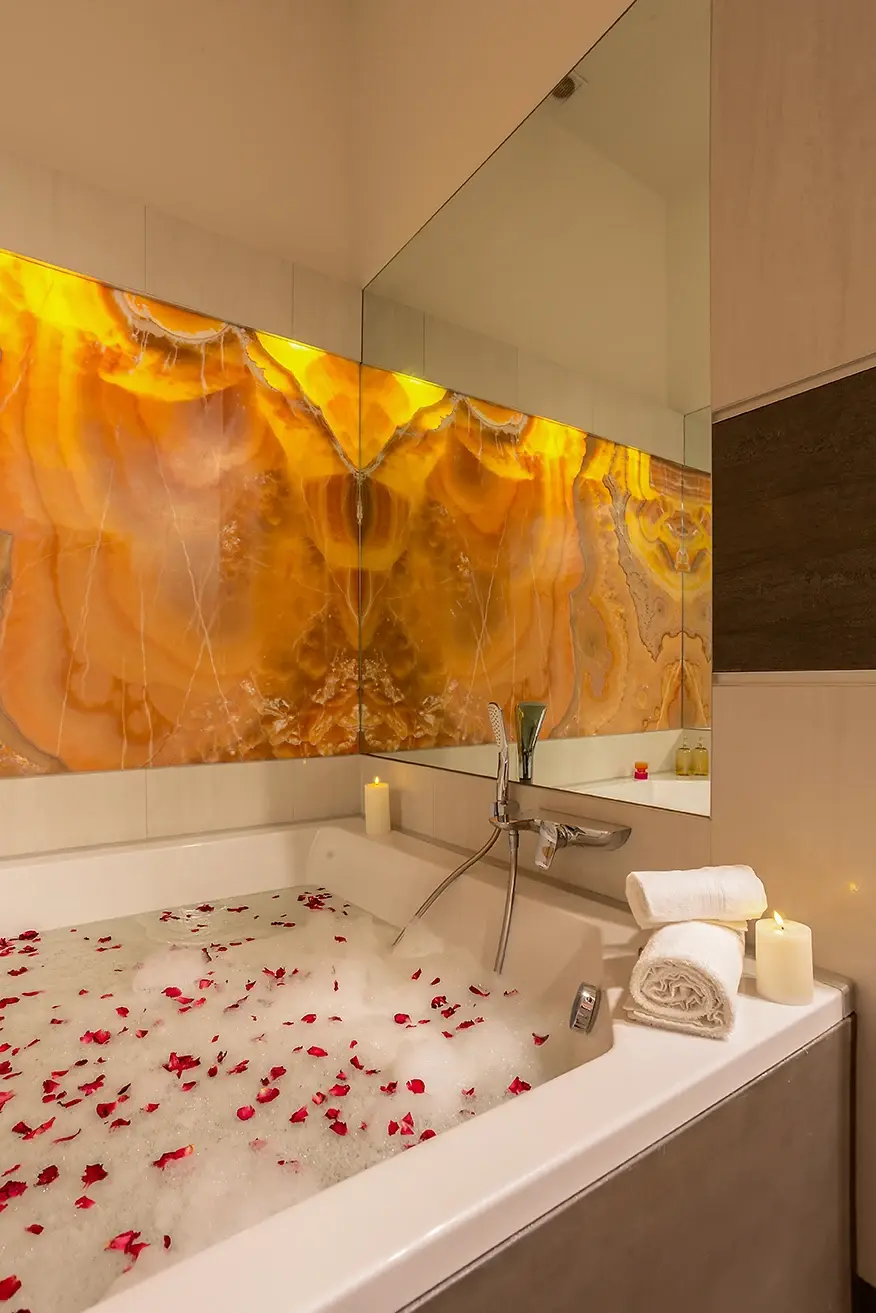
- More attention — 160 minutes, €370 (150 000 Ft). An aromatic bath, unhurried touch, then face and feet treatments.
For two guests together, the couple’s ritual includes a guided tantra session for two.
05What people value about it
What people tend to value is less a technique than a quality of attention. In everyday life, touch is usually brief and has a purpose. Here it is slow and continuous, and it asks nothing back. Many guests describe that as the rare part.
In practice, that can mean:
- Presence. For an hour, the mind follows the body instead of the calendar.
- Relaxation that stays awake. Not drowsiness, but a quieter, steadier kind of attention.
- A calmer pace afterwards. Many describe leaving slower and less hurried than they arrived.
Sometimes a ritual also brings up feeling — relief, tenderness, a wish to stay quiet for a while. That is ordinary, and nothing needs explaining. It is also why we say it plainly: a tantra session is a relaxation ritual, not therapy, and it is not a substitute for medical or psychological care.
06Myths and misunderstandings
“Tantra is about sex.” Popular Western culture has largely equated the two. Historians and museum curators describe this as a narrowing: most tantric practice centred on ritual, mantra, meditation and initiation.
“Tantric massage is an ancient technique.” The traditions are old. The massage is modern, developed in Europe in the second half of the twentieth century.
“You need to be spiritual, flexible or experienced.” No belief and no yoga practice is required. Breathing and a willingness to slow down are enough.
“There is a right way to receive it.” There is nothing to perform. If your mind wanders, you notice and come back. That is all.
“It is the same everywhere.” It is not standardised. Ask any studio what its version includes before you book.
If you would like to try it, the Special session places the breath-led tantra session at the centre of a focused, unhurried hour. If this is your first visit, First expression gives everything a little more room, beginning with a warm shower ritual. Tell us what you are curious about when you write, and we will help you choose.
Questions
Do I need any experience with tantra or yoga?
No. You do not need to know anything about tantra, yoga or meditation. At the start, your therapist asks how you feel and what pace you prefer, then guides you through each stage of the ritual. If you already practise yoga or meditation, some elements may feel familiar, but that is no advantage. Beginners are just as welcome, and nothing is expected of you except to receive.
Is tantric massage spiritual?
It draws on ideas that come from religious traditions in India, but at COHEN no belief or spiritual practice is involved or required. You can experience the tantra session simply as slow, breath-led massage that invites presence and deep relaxation. If you have a spiritual practice of your own, you are welcome to bring that attention with you. If you do not, nothing is missing.
Is it suitable for couples?
Yes. The couple’s ritual is designed for two guests together: a candlelit bath with rose petals, refreshments and fruit, a full-body massage and a guided tantra session for two, closing with face and feet treatments. It lasts 120 minutes and costs €500 (200 000 Ft) per couple. Both guests need to be adults, sober and comfortable with the plan. All couples are welcome.
How long is a tantra session?
At COHEN the tantra session is a stage within each ritual, so its length depends on the ritual you choose and on the pace your therapist sets for you. The rituals last 60, 100 or 160 minutes, and the couple’s ritual 120 minutes. Ritual time does not include arrival, the shower or the short consultation, so plan a little extra time around your booking.