Close to two thousand years of warm water, from Roman Aquincum to the spa palaces of the early twentieth century — and a quieter way to end the day.
The COHEN team·7 min read·
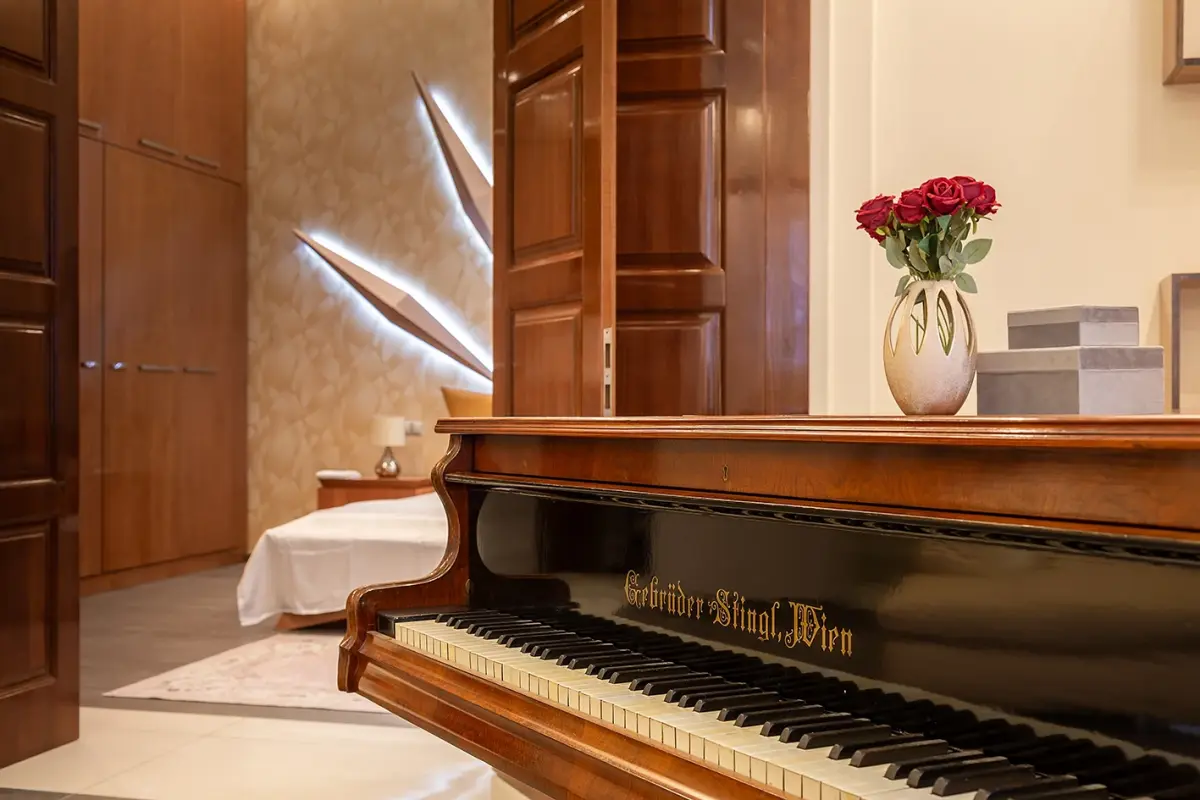
A vintage piano and red roses in the lounge, with a treatment room visible through an open door
Questions
Which Budapest bath is the oldest?
It depends on what you count. The oldest bathing remains are Roman: some foundations and walls of Aquincum’s baths can still be seen in Óbuda. Of the baths in use today, the oldest halls are Ottoman, from the second half of the sixteenth century — the domed octagonal pool of Rudas and the restored Veli Bej. Király is from the same period but has been closed since 2020.
Is a private spa the same as a thermal bath?
No. A thermal bath is a public facility fed by natural thermal water, with several pools and many guests at once. A private spa is a small space booked by appointment, where one guest or a couple has the room to themselves and the focus is on privacy and personal attention rather than on the water. They are different pleasures, and they combine well in one day.
What should I bring to a thermal bath?
A swimsuit, flip-flops, a towel or bathrobe and a bottle of water. Towel and robe rental, lockers and cabins differ from bath to bath, so check the website before you go, and find out whether you need a swimming cap for the lap pool. If you are pregnant or have a medical condition, ask your doctor whether hot water and steam suit you.
How do I combine a thermal bath and a private spa in one day?
Go to the thermal bath first, ideally in the morning or early afternoon. Afterwards, eat something light, drink water and rest for an hour or two, so that you arrive at your ritual neither overheated nor tired. COHEN is open daily from 11:00 to 23:00. Please come sober, and no earlier than ten minutes before your appointment.
Budapest has been a bathing city for close to two thousand years. The Romans built baths beside the warm springs of Aquincum, the Ottomans raised domed bathhouses in the sixteenth century, and the early twentieth century added the spa palaces that still shape the city’s image.
Beneath the city lie more than a hundred natural springs and drilled wells, and in 1934 Budapest officially became a ‘City of Spas’. Here is a short history, followed by a few thoughts on how a public bath and a private spa differ — and how to enjoy both in one day.
This is not a ranking, nor a guide to every pool. It traces where Budapest’s bathing habit comes from, and why there is room in it for something quieter and private.
01Aquincum: the Roman beginnings
Long before Buda and Pest, the Celtic Eravisci settled around what is now Gellért Hill. Then came the Romans, who built Aquincum near the west bank of the Danube, in what is now northern Budapest and Óbuda. In 106 AD the emperor Trajan made it the capital of the province of Pannonia Inferior; Hadrian raised it to a municipium in 124, and Septimius Severus to a colonia in 194. Its name is traced to an earlier Celtic one, Ak-ink, usually translated as ‘abundant water’ — a nod to the thermal springs nearby.
The Romans made good use of that water. An aqueduct of about five kilometres carried spring water to the military camp, and the town had a number of bathhouses; the city’s spa operator counts fourteen. Some of their foundations and walls can still be seen in Óbuda.
For the Romans, a bath was not a single pool but a complex of rooms for bathing, rest and company. Something of that idea survives in every Budapest bath today. You do not simply swim; you move from one temperature to the next, and you stay a while.
02The Ottoman bathhouses that still stand
Buda was under Ottoman rule from 1541 to 1686, and that century and a half left the city baths with an atmosphere of their own. The Ottomans built bathhouses over the hot springs in the hammam tradition: a domed hall, warm and dim, with a pool at its centre.
Several still stand. Three are worth knowing:
Rudas, at the foot of Gellért Hill, was commissioned by Sokollu Mustafa, Pasha of Buda from 1566 to 1578. Its heart is still the octagonal pool beneath a dome ten metres across, carried on eight pillars.
Király dates from the same decades, and much of its present building goes back to the Ottoman period. It has been closed since March 2020.
Veli Bej, a domed bath from the 1570s, reopened in the early 2010s after a full restoration.
The Turkish bath at Rudas is not always open to men and women at the same time on weekdays, so check the schedule before you go.
Step inside one of these halls and the logic of the place is clear: little light, warm stone, water at the centre, and the world outside held at a distance. The exact construction dates vary a little from source to source, but the second half of the sixteenth century is common ground.
03The golden age of the great spa palaces
In 1873 Buda, Pest and Óbuda were united into a single city. Over the next half-century, the new capital gave its springs grand new buildings.
The key was water from deep underground. On the initiative of the mining engineer Vilmos Zsigmondy, deep wells were drilled in City Park, and by 1881 a temporary ‘Artesian bath’ was already operating there.
The Széchenyi bath grew out of that source. Győző Czigler designed it but died in 1905; construction began in 1909, and the bath opened in the summer of 1913 as the first thermal bath on the Pest side. Its outdoor section followed in 1927, and a second well, about 1,256 metres deep, was drilled in the late 1930s.
The Gellért bath rose at the foot of Gellért Hill during the First World War, between 1914 and 1918, to plans by three Hungarian architects. Its late Art Nouveau halls, decorated with organic patterns, opened in 1918; the wave pool, built where the bath’s park had been, followed in 1926–27. The site itself is far older than the building: a bath stood here in Ottoman times, and the spa operator traces a hospital and bath on the spot back to the thirteenth century.
Older baths changed too. Rudas, for example, gained a swimming pool in 1896. By the 1930s the city offered almost every kind of bathing: Ottoman domes, palatial halls, a wave pool and open-air pools.
04Why Budapest is called the City of Spas
In 1934 Budapest officially received the title of ‘City of Spas’ — in Hungarian fürdőváros, literally a bath city. The title put a name to something the springs had made possible long before.
The reason lies underground: more than a hundred natural springs and drilled wells, with water ranging from lukewarm to almost 80°C. Sources give slightly different counts, so ‘more than a hundred’ is the safe way to put it. By the spa operator’s figures, some 70 million litres of thermal water reach the surface every day.
Even half of the city’s name may be tied to warm water. According to the Budapest City Archives, some researchers trace ‘Pest’ to a Slavic word for a stove or kiln, a reference to the warm springs on and around Gellért Hill.
The springs shaped habits as much as architecture. For generations, warm water has been part of ordinary life in Budapest: something for a weekday afternoon, not only for a holiday.
For visitors, the appeal is the range. A Roman ruin, an Ottoman dome and an early twentieth-century spa palace, all within one city, and all built around the same warm water.
05Public baths and private spas today — two different pleasures
A public thermal bath is a place to share. You move between pools of different temperatures, among locals and visitors, for as long as your ticket and your energy allow. There is history in the walls and noise in the air, and that is part of the charm. The municipal spa company lists a dozen baths and lidos today, from Széchenyi and Rudas to the Palatinus on Margaret Island. Weekends and holidays can be busy; if you can, go on a weekday morning.
A private spa is the opposite in almost every way: small, quiet and booked by appointment, with your time arranged around you rather than around a crowd. You give up the scale and the thermal water; you gain privacy, an unhurried pace and the attention of a therapist. We look at the difference more closely in What is a private spa.
Neither replaces the other. They sit well together on the same trip: the baths for the city’s history, a private spa for an evening that belongs to you.
If your time in the city is short, choose one historic bath and give it a whole morning or afternoon, rather than rushing through three. Thermal water rewards slowness too.
06A quiet ritual after a day at the baths
A day at the baths is warm, social and more tiring than it looks. You may well finish it wanting the opposite: a room with low light, no crowd, and someone who takes their time.
If so, leave a gap between the two. Eat something light, drink water, rest for an hour or two, and let the heat leave your body before your ritual begins. COHEN is open every day from 11:00 to 23:00, at Hold utca 25 in Lipótváros, District V; visit details are on our contact page. Please come sober, and no earlier than ten minutes before your time. Everyone over 18 is welcome, of any gender or orientation.
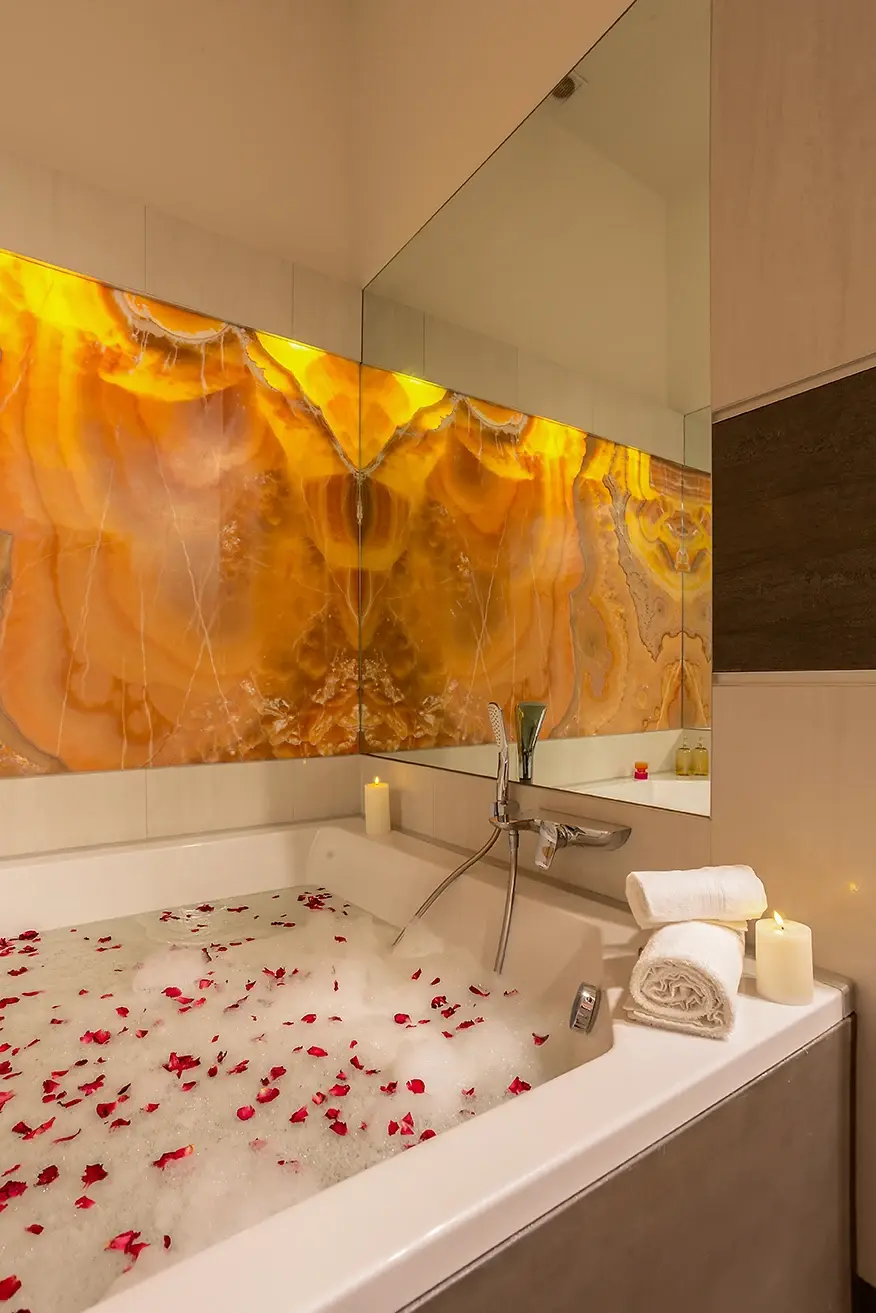
For an evening built around water of a different kind, More attention begins with a hot, fragrant bath of your own, continues with unhurried touch, and closes with a face and feet treatment — 160 minutes, €370 (150 000 Ft). It is on our rituals page, alongside shorter rituals for days when you have had enough water already.